League of Legends from the industry perspective
The first online games started to emerge in the prehistoric era of the internet network with bulletin board system (BBS) through which a computer server was connected to users by phone lines. Soon multiuser BBSs started to allow user interaction inside games and gradually the simple-text design-based environments incorporated more complex graphics. With cheaper technologies for PCs in the late 90s, the online feature started to be offered among different game genres via broadband internet connection. With the possibility of sophisticated 3D visuals and servers allowing simultaneous connections of thousands of users, multiplayer online games became one of the most popular categories. In this essay we will continue the analysis of the video game League of Legends already explored on the previous post, but this time our main focus will be the industry perspective. We will explore some characteristics that made League of Legends a successful franchise and, comparing with other sectors in media like the TV and recording industries, understand that League of Legends also became a transnational enterprise. As we will see, the growth of these industries meant an important change in the audience that shifted from the homely amateur to the competitive professional.
Released in 2009, League of Legends was conceived as a multiplayer online game, following the momentum created by online multiplayer role-playing games like the WarCraft franchise. It began with an innovative business model: free to play but using the micro transaction concept inside the game. These purchases are made while using Riot Points, an in-game currency concept to monetize the sale of champions, champion skins, icons and multi-game boosts. Their fan community is huge and very active in YouTube where guided videos instruct players to face their enemies (read more about the LoL community in part 1). It is noteworthy that the sense of community allied to the inherent competitiveness inside the game and in-game currencies created a new profile of players that actually make a living as gaming professionals. In this sense it is worth mentioning Twitch, a social video platform and community for gamers where individuals stay connected for hours in real-time (this creates a spect-actor, a concept we explored here). Some of them are expert professionals that charge $4.99 for their channel’s subscription and receive donations that can vary from $5 to $500. We also reviewed a channel called “Arams con vosotros” owned by a Spanish player who before the start of a match commented that he was invited by an American firm to go to USA to test a new game. In his channel he shows his complete profile including partnerships with game resellers, fans’ comments, and a list of top donators.

In Tasha Oren’s article On the Line: Format, Cooking and Competition as Television Values, she explores the changes of food TV programs that evolved from the early domestic kitchen to a restaurant-set highlighting the competitive professional performance. As we see, the same happened in the gaming environment where the amateur profile of players shifted to professionalized experts (as we will discuss later, the competitive character was also inserted in the gaming culture under the eSports category). Oren underlines the bridge of the cooking environment with games and, more related to what we are exploring, with video games. As discussed by David Marshall, the game culture is stimulating a reconfiguration of other industries towards interactivity and intertextual associations across media products (Oren, 2013:32). Actually, marketing researchers are recognizing the video game industry as the fastest growing and exciting category of mass media for the coming decade, characterized by a high degree of innovation. They also stress the bridge to other entertainment industries such as those products that offer hybrid experiences – for example, Lord of the Rings as a game, movie, and other merchandise (Marchand and Hennig-Thurau, 2013:141). We will show next that League of Legends is already in this track and behind the game there is a structure working to engage more players by offering them the same kind of competitive experiences that Oren discusses in her article.
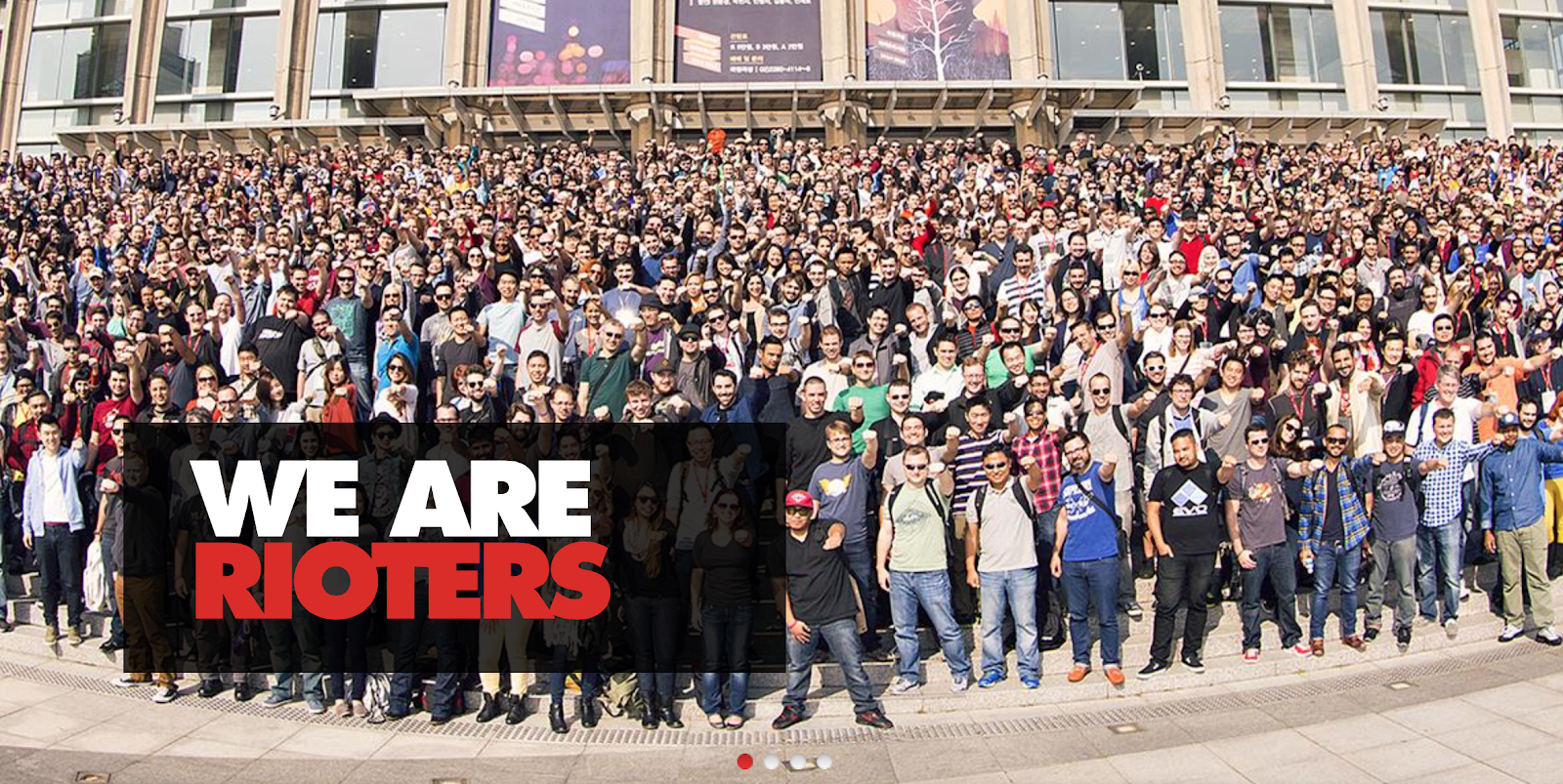
The structure behind League of Legends is Riot Games, an American developer with headquarters at 17 cities around the world. Although they state on their website “We create competitive, PvP, online games for gamers”, League of Legends is actually their only title. With a monthly audience of 67 million players, the firm strives to find a huge workforce to fill open jobs around the world, ranging from events management to finance, narrative, player support, art, game design, production, e-commerce, among several others (Riot Games figure at #13 position on Fortune’s 100 Best Companies to Work For list). Actually, besides the funding from micro transactions, Riot has a full range of merchandise materials for fans available on Riot Games Merch with products ranging from t-shirts to posters, statues and accessories. Additional to generating revenue, the merchandise also serves as a way for the fans of the game to create their own “imagined community” (Anderson, 2006 [1983]), a complex and dynamic process we explore here. Beyond that, Championships promotion also plays an important role in making League of Legends one of the most played video games of the world .
The first League of Legends competition was a tournament held during the 2010 World Cyber Games at which teams from China, Europe, and the Americas competed with a $ 7.000 prize. Since then, Riot Games started to promote annual Championships offering $1.550.00 in prizes each year. Events like these help to reinforce the importance of the whole category of eSports but, more important than that, highlight League of Legends as one important player in the video game industry. On top of that, it serves as a platform for fans of the game. Nowadays eSports championships are comparable to usual sports, taking thousands of spectators to indoor arenas and stadiums, being transmitted in several languages via online live broadcast. As we discovered, this year one League of Legends British team was being sold for an amount surpassing $500.000.
Unlike other competitors that develop games serially, Riot Games has put all its energy in transforming League of Legends into a successful global franchise format. Besides the international headquarters, the merchandises, the licensing and distributing partnerships, Riot Games is focused on the power of these championships as strong promoters of League of Legends. Because of this, although the events and teams are managed by third parties, Riot Games stays involved to assure the best results. The process follows the same tracks that Katherine L. Meizel describes in Idolized about the global franchises and geopolitics of Idol TV show. She justifies the successful reach of Idols franchise with the twin processes of globalisation and consolidation in the media industry plus the wave of democratization (Meizel, 2010:206). In our study case, concerning to the democratic feature, the voting process of Idols is substituted by the free-to-play business model, the growing accessibility of the game (via technology and internet access) and game features ensuring that a competitor will face an opponent with equivalent capabilities. As Meizel points out, “these values of democratic competition are also central to the competitive individualism that stars in the early-twenty-first-century American Dream” (Meizel, 2010:212). In this sense, similarly to Idols, eSports championships are leveraging players to global stardom and becoming a replicable format very similar to those found in the TV industry. Furthermore, just like the Idols franchise, League of Legends owns its success to globalisation.
In The making of an entertainment revolution: How the TV format trade became a global industry, Jean K. Chalaby describes TV formats as transnational operations. The two key aspects that Chalaby underlines in TV formats are present in the broadcast of League of Legends. First, formats offer a distinctive narrative dimension “with all the highs and lows, tensions and conflicts, twists and conventions of drama” (Chalaby, 2011:294). As we see in championship videos on YouTube, a set of elements work consistently to insert drama and trigger moments: a stage with neon and spotlights, the central futuristic scenario with two opposite teams sitting in ergonomic chairs; the surrounding audience; and an additional team of commentators and moving cameras injecting thrilling speculations about what is about to come. Secondly, the way the championships are broadcast shows an inherent transnational character. As we saw, similarly to TV format, Riot Games inputs rules for event and team managers because the franchise success depends on showing economic benefits for future licensees.
Ever since the early days of the internet until today, the game industry made a leap pushed by a constantly evolving technology inside game devices, computers and the internet. A new globalised environment contributed to a shift in the industry as a whole and players were given the choice of having an amateur profile or living a routine of improvement based in training and succeeding as gaming professionals. Although game industry companies are not so well known by the general public as the TV / recording corporations are, it is clear that it influences other media industries. Moreover, the game industry is also driving transnational processes, transforming cultures across geographic, economic and political boundaries.
Discussion: Since eSports are taking the shape of a transnational enterprise, what is missing to make this new sport category reach the general audience?
B.L., E.K., L.C., N.R., R.H.
________________________________________________________________________
Bibliography
Oren, Tasha. "On the Line: Format, Cooking and Competition as Television Values." Critical Studies in Television: An International Journal of Television Studies 8.2 (2013): 20-35.
Meizel, K. (2011). Idolized: music, media, and identity in American idol. Indiana University Press.
Chalaby, J. K. (2011). The making of an entertainment revolution: How the TV format trade became a global industry. European Journal of Communication, 26(4), 293-309.
Marchand, André, and Thorsten Hennig-Thurau. "Value creation in the video game industry: Industry economics, consumer benefits, and research opportunities." Journal of Interactive Marketing 27.3 (2013): 141-157.