Meet Nigeria’s film industry: Nollywood!

You probably heard of Bollywood, and we are almost positive that you have seen some of Hollywood’s finest blockbusters. But did you ever hear of Nollywood? Similar to the way Daya Kishan Thussu discusses Bollywood as a global media contraflow of Hollywood, in his article Cultural Practices and Media Production: The Case of Bollywood (Thussu, 2012), in this blog we will discuss Nollywood as another transnational cultural flow. Lagos, the largest city in Nigeria, ‘is one of the most chaotic, least planned mega-cities, and yet out of it has grown the newest major film industry in the world: Nollywood.’ (Hartley et al, 2013:47). In 2009, Nollywood surpassed Hollywood as the world’s second largest film industry by volume, right behind India’s Bollywood. It is a $3.3 billion sector, with 1844 movies produced in 2013 alone (http://fortune.com). We will discuss the cultural production of this film industry, in its wider transnational context of media globalization. We will start by arguing the ambiguity of the term Nollywood and provide a small description of what Nollywood entails and how it came into existence. Moreover, we will focus on the important role Nigerian films have on its diasporic audience, as it serves as a cultural guidebook connecting to the home country. Finally, we will show how the African diaspora living in China is a source of transnational creativity, as the African film King of Guangzhou shows. We will conclude the blog by regarding it as a starting point for further research.
The term Nollywood, a take-off on the popular Bollywood films from India, is invented by a non-Nigerian to describe the Nigerian film industry. The term first appeared in an article by Matt Steinglass in the New York Times in 2002 and continued to be imposed by foreigners to Nigeria (http://nollywoodjournal.com). Even though the term Nollywood is used to describe the film industry, just like Bollywood for Indian films, there are those who resist the name in favour of something else. Prince Bubacarr A. Sankanu, a Germany-based Gambian film and TV producer, explains: ‘the foreign-imposed "Nollywood" name is neocolonial, subservient and derogatory’ (https://www.linkedin.com). According to him, Nigerian Cinema has more to offer than "Nollywood" which can not be the supreme definition, origin and future of what Nigerian film culture and industry should be like. He prefers the term Cinenaija, which literally means ‘cinema of Nigeria’ as cine is derived from cinema and Naija is the authentic name Nigerians use to describe their nation (http://www.africanexecutive.com).


The emergence of film industry Nollywood goes back to the late 1980's and early 1990's, when movie theaters closed because of growing epidemics of crime and insecurity. Videos for home viewing imported from the West and India were only mildly popular and so Nigerians saw the opportunity to fill the void with products of their own (http://nollywoodjournal.com). This ties in with the concept of ‘cultural proximity’ (Huat, 2011: 233), when audiences desire their own language & culture in the media. Nollywood offers its audience characters they can identify with in stories that relate to what they confront daily. The settings are familiar and the film’s stars native Nigerians (www.thisisnollywood.com). It all started in 1992, when electronics salesman Kenneth Nnebue shot a straight-to-video movie in one month, on a budget of just $12,000. Living in Bondage sold more than a million copies, mostly by street vendors, and film industry Nollywood was born (http://fortune.com).
And so, the film industry evolved ‘out of an informal economic base reliant on pirate networks that have gone commercial, with absolutely no state subsidy or other support mechanisms, Nigerian video is low-tech, low production quality, high-volume filmmaking servicing mostly the urban poor’ (Hartley et al, 2013:47). An average production takes just 10 days, it costs approximately $15,000 and the films go straight to DVD and VCD discs. Shooting is inevitably delayed by obstacles unimaginable in California, as star actors regularly don't show up when they're supposed to and location shooting is often delayed by local thugs (www.thisisnollywood.com). Even so, Nollywood producers are indomitable, they have struck a profitable and long-neglected market and continue to make movies at a fast rate.
 The appeal of Nollywood stretches far beyond Nigeria, as the films prove to be popular among African diaspora. Diaspora are by definition collective and ‘linked through multiple transnational networks and connections with their culture and/or place of origin, with each other in various locations and the societies in which diasporic groups permanently reside’ (Berghahn & Sternberg, 2010:14). The Nigerian films are important influences, as Femi Odugbemi, a Nigerian documentary filmmaker explains ‘for Africans living in the Diaspora, Nollywood has for long represented much more than entertainment. It has been their link to the homeland. Nollywood films have been the ready references to their children and neighbours of the details of their cultural identity’ (http://blogs.indiewire.com/). So, according to Odugbemi Nollywood is ‘Africa's voice to the world’, a cinema that goes beyond entertainment, but provides a representation of Africa’s culture and therefore is all about identity.
 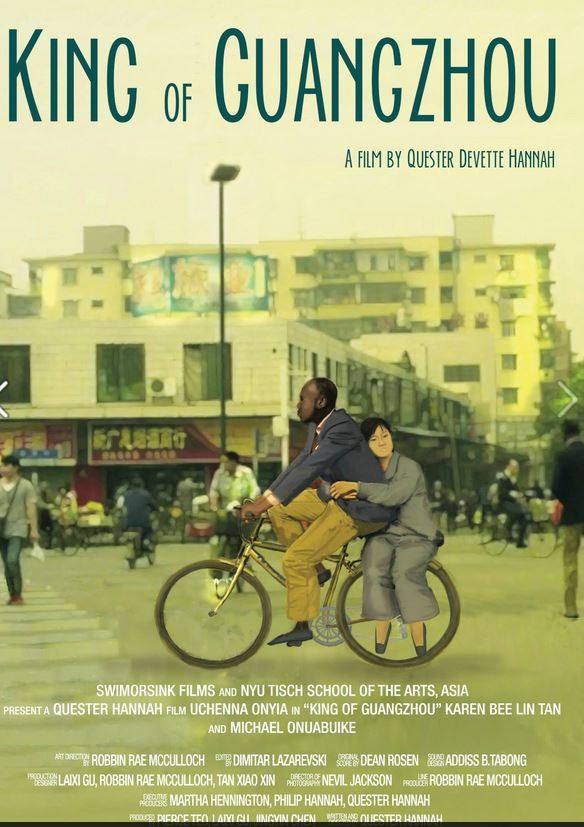 Nigerian films offer African diaspora a reference book, a glimpse of African life and at the same time, diasporas are a source of creativity. ‘'While their relationship with societies of settlement may be challenging in a number of ways, diasporas also ‘enrich life in host countries’, contributing not just to the economy but also to creative and cultural pluralism and diversity (Cohen 2008: 17)' (Berghahn & Sternberg, 2010 :14). This is certainly true for the large diasporic community of Nigerians living in China. Guangzhou is actually nicknamed "Chocolate City" by the Chinese, as between 20 and 100.000 Africans, mainly Nigerians, live there. According to Nusa Tukic, professor in Cultural Relations between China and Africa, the large Nigerian diaspora in Guangzhou explains the interest in African films that take place in China (http://chinafrica.info/). An example of such a film is King of Guangzhou (2013) directed by Quester Hannah, a narrative short film about a Nigerian man who struggles to stay in China despite facing deportation. King of Guangzhou is just one example of a film in which filmmakers explore cultural diversity and portray the large African diaspora in China.
As we have seen, Nigerian films spread far beyond Nigeria’s borders and is a reference book of authentic values and traditions for African diasporas. Guangzhou is a city that houses one of these diasporic communities and their experiences serve as inspiration for films such as King of Guangzhou. Apart from what we discussed in our blog, there are more aspects of Nollywood that are worth of critical discussion. We were limited in our expansion on this topic and we are aware of the fact that it raises more questions. Such as whether Nollywood is the correct term for addressing the Nigerian film industry? Can Nollywood as an international cultural flow be considered as a challenge to the hegemony of Hollywood? How is the Nigerian film industry related to other film industries in Africa? How will the technological development of Nollywood influence the production, and distribution of Nigerian films? It certainly requires more research and discussion to analyse this booming film industry, outside the scope of this blog.
B.L., E.K., L.C., N.R., R.H.
Thesis: Is it possible for the Nigerian film industry to excess the boundaries of the African diaspora by touching a broader audience?
Sources:
Chua Beng Huat (2011), ‘East Asian Pop Culture’, in: Felicia Chan, Angelina Karpovich & Xin Zhang (eds.), Genre in Asian Film and Television: New Approaches. Basingstoke: Palgrave Macmillan.
Daya Kishan Thussu (2012), ‘Cultural Practices and Media Production: The Case of Bollywood’, in: Isabelle Rigoni & Eugénie Saitta (eds.) Mediating Cultural Diversity in a Globalised Public Space. Basingstoke: Palgrave Macmillan.
Daniela Berghahn & Claudia Sternberg (2010), ‘Locating Migrant and Diasporic Cinema in Contemporary Europe’, in: Daniela Berghahn & Claudia Sternberg (eds.), European Cinema in Motion: Migrant and Diasporic Film in Contemporary Europe. Basingstoke: Palgrave Macmillan.
Hartley, J., Potts, J., Cunningham, S., Flew, T., Keane, M. & Banks, J. (Red.). (2013) Key concepts in Creative Industries London: Sage Publications
https://www.facebook.com/QuesterHannahActor/timeline
http://www.thisisnollywood.com/nollywood.htm